Moscow, Idaho, March 30, 2024: A recently published studyi in Nutrition Journal, an open-access peer-reviewed scientific journal, demonstrates that eating beans (including canned and/or dry packaged kidney beans, black beans, and/or pinto beans) and chickpeas is associated with greater intake of shortfall nutrients, including nutrients of public health concern, and significantly higher diet quality scores. Additionally, the study finds that bean and/or chickpea consumption is associated with improved weight-related outcomes, including lower body mass index, body weight, and improved waist circumference. This new research adds to the growing body of evidence that showcases the multiple benefits of including beans and chickpeas as part of a healthy dietary pattern.
Researchers analyzed data from the National Health and Examination Survey, 2001-2018, to identify patterns of bean and/or chickpea consumption compared to those who do not consume any beans or chickpeas. Results show that adults who consume beans and/or chickpeas daily have significantly higher diet quality scores compared to those who do not. Bean and/or chickpea consumers also have significantly higher intakes of several shortfall nutrients, including choline, alpha-linolenic acid, folate, iron, magnesium, and vitamin E. Similarly, dietary fiber, potassium, and calcium (nutrients of public health concern) are significantly higher in the diets of bean and/or chickpea consumers. Finally, the study showed that adults who consume 1.7-2.0 servings of beans and/or chickpeas per day had significantly lower Body Mass Index (BMI), decreased body weight, and smaller waist sizes compared to the non-bean and/or chickpea consumers.
“Most people are aware that beans and chickpeas are good for your heart, but our new research shows they are really good for so much more – like improving nutrient intake and healthier dietary patterns,” states author Yanni Papanikolaou, of Nutritional Strategies Inc. “Our analysis shows that canned and dry beans and/or chickpeas help close nutrient gaps, and fuels nutrient-dense diets in the US. Conversely, the data suggests that avoiding beans and/or chickpeas may lead to nutrient deficits and public health consequences in adults.” The study was funded by the Coalition for the Advancement of Pulses and Cannedbeans.org.
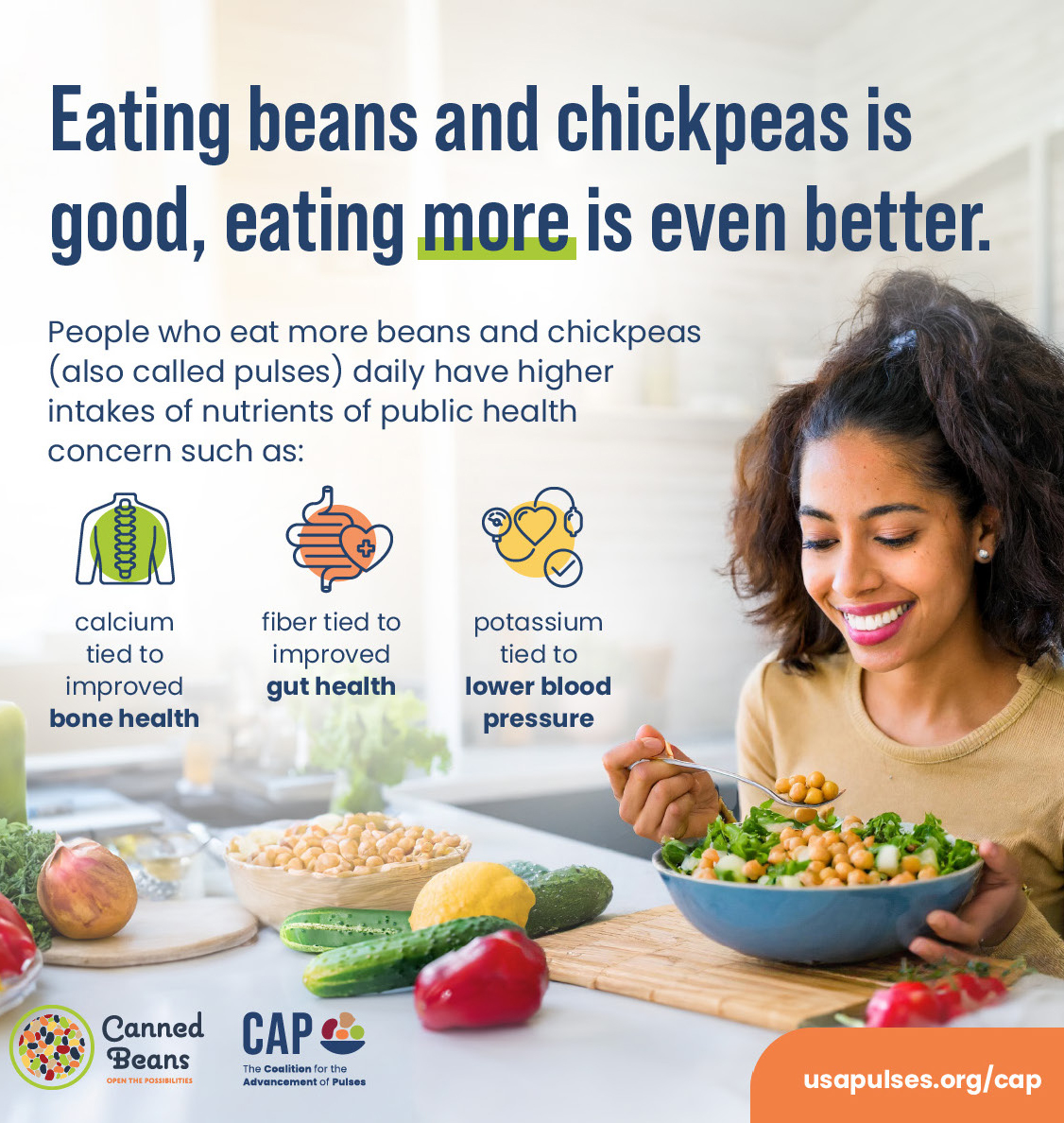
Those who eat beans and/or chickpeas as part of a healthy dietary pattern have significantly higher intakes of nutrients that are most frequently under-consumed, known as shortfall nutrientsii compared to non-bean eaters.i Bean and/or chickpea eaters also have higher intakes of fiber, calcium, and potassium,ii termed nutrients of public health concern because low intakes of these nutrients are Ced to common health problems in the U.S. population. Low intakes of potassium are linked to high blood pressure, stroke, type 2 diabetes, and poor bone health.iii Low intakes of calcium are thought to play a role in bone health in older adults, cancer, cardiovascular disease (CVD), weight management, and metabolic syndrome.iv Fiber is woefully under-consumed in the U.S. diet and diets high in fiber are linked to gut health, lower cholesterol levels, blood sugar control, healthy body weight, and longevity.v
The findings are consistent with the body of existing peer-reviewed studies that show the inclusion of pulses (beans, chickpeas, peas and lentils) as part of a healthy diet imparts countless health benefits, including cardiovascular, metabolic, and gut protective effects; improved weight outcomes and low-grade inflammation, and may play a role in immune-related disease risk management.vi The nutrient density of beans and chickpeas and their contributions to diet quality have been documented by the most recent collaboration between the National Cancer Institute (NCI) and the United States Department of Agriculture (USDA) to update the Healthy Eating Index (HEI) diet quality scale. vii,viii,ix
“This research underscores the fact that pulses are nutritional powerhouses,” said Tim McGreevy, CEO, of USA Pulses. “It’s very clear that eating beans and chickpeas is good and that eating more is even better.”
“The research shows that canned or dry, beans and/or chickpeas pack a nutrient punch. They help close nutrient gaps and are high in fiber, protein, and several important macronutrients,” said Rebecca Bratter, Executive Director of the US Dry Bean Council.
The Dietary Guidelines for Americans 2020 – 2025 and the USDA’s Choose My Plate indicate that beans, chickpeas, peas, and lentils can be considered as part of the vegetable or protein groups.
ABOUT THE COALITION FOR THE ADVANCEMENT OF PULSES
The Coalition for the Advancement of Pulses (CAP) is an initiative led by the American Pulse Association (APA) with support from the USA Dry Pea and Lentil Council (USADPLC), the U.S. Dry Bean Council (USDBC), and the Pulse Foundation. The CAP coalition represents a collective of pulse crop growers, processors, manufacturers, and related organizations. CAP is committed to increasing the consumption of pulses in the United States by increasing research on the nutritional benefits of pulses and growing awareness about the many health benefits of pulse crops. For more information visit usapulses.org or contact CAP@usapulses.org
ABOUT CANNEDBEANS.ORG
Cannedbeans.org, sponsored by Bush’s Best®, is a category-building marketing campaign aimed at promoting the universal health benefits of canned beans regardless of brand. Containing fiber, protein and iron, canned beans make it easy to add more plants to your diet and help people live longer, healthier lives. For more information, check out the latest tools, recipes, and resources below to learn more about the benefits of canned beans at www.cannedbeans.org.
i Papanikolaou, Y., Slavin, J. & Fulgoni, V.L. Adult dietary patterns with increased bean consumption are associated with greater overall shortfall nutrient intakes, lower added sugar, improved weight-related outcomes and be<er diet quality. Nutr J 23, 36 (2024). https://doi.org/10.1186/s12937-024-00937-1
ii Mitchell DC, Marinangeli CPF, Pigat S, Bompola F, Campbell J, Pan Y, Curran JM, Cai DJ, Jaconis SY, Rumney J. Pulse Intake Improves Nutrient Density among US Adult Consumers. Nutrients. 2021 Jul 31;13(8):2668. doi: 10.3390/nu13082668. PMID: 34444828; PMCID: PMC8398140.
iii Potassium: A Health Professionals Fact Sheet available from Office of Dietary Supplements at h<ps://ods.od.nih.gov/factsheets/Potassium-HealthProfessional/)
iv Calcium: A Health Professionals Fact Sheet available from Office of Dietary Supplements at https://ods.od.nih.gov/factsheets/Calcium-HealthProfessional/
v Dietary Fiber. Mayo Health available at https://www.mayoclinic.org/healthy-lifestyle/nutrition-and-healthy-eating/in-depth/fiber/art-20043983?p=1
vi Mullins AP, Arjmandi BH. Health Benefits of Plant-Based Nutrition: Focus on Beans in Cardiometabolic Diseases. Nutrients. 2021 Feb 5;13(2):519. doi: 10.3390/nu13020519. PMID: 33562498; PMCID: PMC7915747.
vii Drewnowski A. Concept of a nutritious food: Towards a nutrient density score. Am J Clin Nutr., 2005; 82:721-732.
viii Drewnowski A. The Nutrient Rich Foods Index helps to identify healthy, affordable foods. Am J Clin Nutr. 2010:91:1095S-1101S.
ix National Cancer Institute, Overview and Background of the Healthy Eating Index